Saturday, April 13, 2013
Rash of Injuries
There have been a lot of injuries lately in professional sports, from Zack Grienke to Jose Reyes to Kobe Bryant. On Wednesday night, Grienke, a right handed pitcher for the Dodgers, fractured his left clavicle after fighting with Carlos Quentin. It's difficult to tell if the injury occurred during the initial collision or when Grienke hit the ground. The clavicle serves as the link between the axial skeleton and the appendicular skeleton. Anytime you move your shoulder, the clavicle rotates as well. Although Grienke broke his left clavicle, and he is right handed, the left arm is still important for a right handed pitcher. Grienke had surgery to place a rod in the clavicle and help stabilize it. The Dodgers estimate he will be out for around 8 weeks. Once the injury heals, he will have to build his arm strength back up and undergo a rehabilitation assignment in the minor leagues before he can pitch in a major league game. This will likely take about 2-3 months.
Thursday, March 28, 2013
Cameron is Two
This post is not really kinesiology related, but Cameron turned two last Friday, and I thought I would add some pictures of him to the blog. He has grown up so much the past two years and is really smart. I said I wouldn't try to force him to learn his anatomy, but he really enjoys learning information and I just couldn't resist. He can point to and say his brain, ears, eyes, nose, mouth, pecs, heart, belly, elbow, shoulder, patellas (it comes out more "tella", but that's impressive for a two year old), and ankle. He can also stretch, show his muscles, and he likes to try and do pushups. Who knows, he might just follow in my footsteps and pursue a career in kinesiology! Below are some pictures of him.
Maybe a future professor?
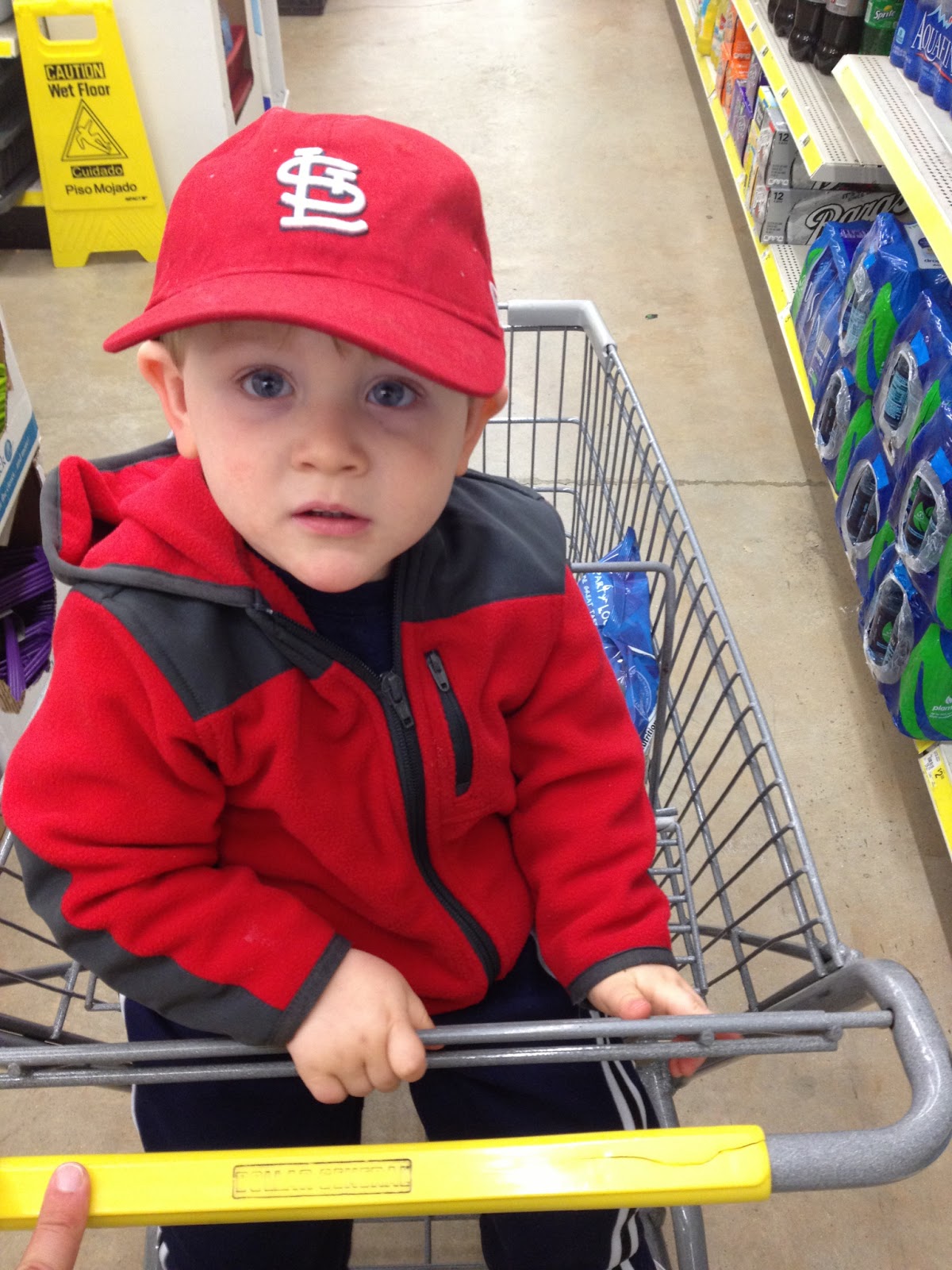
He's finally started wearing baseball caps, so of course it has to be a Cardinals hat!
Pointing to his pecs.
Showing his belly.
Stretching.
He's gained almost 25 pounds and grown around 15 inches in 2 years.
Friday, March 22, 2013
There is hope
If you have read this blog in the past, then you know I hate the term "muscle memory." Just a short recap, but the reason for this is that the muscle cannot remember anything. All movement is a coordinated process between the nervous system and the muscular system. However, athletes, coaches, and even so called experts on ESPN (I'm talking about you Sport Science Guy) continue to use the term. It was refreshing to read an article this week about Cleveland Indians pitcher Trevor Bauer and his attempt to change his pitching mechanics, and to hear him use the words "neuromuscular programming" instead of "muscle memory." He essentially said that by attempting to change his pitching mechanics, he is trying to overwrite 10 years of neuromuscular programming. I don't know a lot about Bauer but he seems like a very smart guy. He is essentially attempting to make some changes to his throwing motion, and this will require the brain to activate different motor units at different frequencies and with different timing patterns. Neuromuscular programming is a good description of what is going on. It is certainly better than muscle memory. Hopefully more athletes and coaches will start to use this terminology and it will start to replace incorrect terminology.
Sunday, March 17, 2013
Classic Lateral Ankle Sprain
Last Wednesday night, Kobe Bryant suffered a lateral ankle sprain. You can see the video here. Bryant went up for a shot and his left foot landed on the foot of the defender, forcing his ankle into inversion (bottom of the foot turning towards the mid-line) and plantar flexion (foot pointing down). This type of mechanism of a lateral ankle sprain occurs commonly in sports like basketball and volleyball. The players are in close proximity to each other which increases the likelihood of them landing from a jump onto the foot of another player. The reports said Bryant suffered a severe ankle sprain, but since he was able to attempt to play on Friday, it was likely a Grade II (moderate) ankle sprain.
You can see in the picture above that the mechanism of a lateral ankle sprain damages the lateral ankle ligaments, which include the anterior talofibular, the posterior talofibular, and the calcaneofibular ligament. Bryant likely suffered damage to all 3 ligaments. The best treatment of this injury is a period of rest, management of pain and swelling, followed by rehabilitation to restore range of motion, strength, proprioception, and functional movements. Since the Lakers are trying to get into the NBA playoffs, rest is not really an option for Bryant (although he isn't playing tonight because of this injury and because he has the flu). This injury will definitely affect him the rest of the season, although he is a great athlete and has shown the ability to play through pain in the past.
Monday, February 25, 2013
Trip to Greenville, SC for SEACSM conference
Early on the morning of February 14, I departed Starkville with 3 undergraduate students for the 2013 Southeast Chapter of the American College of Sports Medicine annual conference in Greenville, SC. The three students were Alisan Abernathy, Murry Adams, and Anna Comer. We had been working together on a research project since this past summer investigating the relationship between ankle joint laxity, balance, and landing kinetics. Each of the students made their own presentation based off of the data we had collected so far. They all did a wonderful job with their presentation and we received several compliments. They also competed in the student quiz bowl and did very well. Below are some picture from the trip. We have a little more data to collect before we start working on a paper to submit for publication.
Murray in action.
Murry and his poster (the girls didn't want individual pictures with their posters.
The students and me.
Getting ready for the quiz bowl.
Taking in a little minor league hockey on Friday night. We had great seats.
Thursday, February 7, 2013
Career Ender
I have blogged previously about Chris Carpenter and the surgery he had last summer for thoracic outlet syndrome. The surgeon has to remove Carpenter's first rib on his right side to take the pressure of the nerves than run from the neck down into the shoulder and the arm. Carpenter had been experiencing weakness, numbness, and a loss of sensation in his right arm for a long period of time. He was able to come back in a little over 3 months and pitch in 6 games at the end of the regular season and playoffs. He pitched about like what you would expect someone to pitch only 3 months removed from major shoulder surgery.
Earlier this week it was announced that Carpenter was having a re-occurrence of the thoracic outlet symptoms that lead to the surgery, and that he would not be able to pitch in 2013, and likely not ever again. Although this was not a complete surprise, given his injury history, it is still a disappointment. Carpenter is one of the best pitchers in Cardinals' history and one of the greatest postseason pitchers ever. However, he has had multiple shoulder and elbow surgeries over the course of his career, and these injuries and surgeries begin to take a toll on the body. Hopefully once he stops pitching the symptoms will subside and he can have a normal life, although he will likely contain to experience some of the symptoms in his throwing arm.
Wednesday, January 23, 2013
Life Threatening Injury
I was reading the latest edition of the NATA (national athletic trainiers association) news and came across the story of Houston football player D.J. Hayden, and how the quick response of his athletic trainer, Mike O'Shea, likely saved his life. If you are a member of the NATA, I encourage you to read the story. If you are not a member, this ESPN.com article offers a pretty good summary of the injury.
The injury that Hayden suffered was a torn inferior vena cava. The inferior vena cava is the large vein that carries deoxygenated blood from the lower extremity into the right atrium of the heart. A tear of this structure results in massive internal bleeding and is a serious medical injury. According to the story in NATA news, Hayden went up to intercept a pass and another teammate's knee hit him just underneath the sternum, right below where the protection from his shoulder pads ended. O'Shea examined Hayden on the field and again on the sidelines, and quickly decided to move him into the locker room. Because Hayden's signs and symptoms were not adding up with a typical chest injury, O'Shea and the team physician went ahead and called the paramedics, who decided to take him to the nearest trauma center. The doctors at the hospital suspected a ruptured spleen or liver, but soon discovered that it was his inferior vena cava that was ruptured. According to the article, there have not been any documented cases of a torn vena cava occurring during athletic competition. It more commonly results from a gunshot wound or car accident.
The doctors were able to repair the rupture in his vena cava, and Hayden is expected to make a full recovery. The doctors stated that the fact Hayden also broke his diaphragm during the injury likely helped save his life, because it allowed the blood from the ruptured vena cava to pool in his adbomen instead of around his heart. The doctors also stated that if he had arrived at the hospital 5 minutes later he likely would have died. This was a remarkable job by the entire medical staff, beginning with the athletic trainer. The typical survival rate for a torn vena cava is around 5%. You never know what may happen when you step out onto the field or court to cover a practice or game, and the actions of this athletic trainer helped save a life.
The injury that Hayden suffered was a torn inferior vena cava. The inferior vena cava is the large vein that carries deoxygenated blood from the lower extremity into the right atrium of the heart. A tear of this structure results in massive internal bleeding and is a serious medical injury. According to the story in NATA news, Hayden went up to intercept a pass and another teammate's knee hit him just underneath the sternum, right below where the protection from his shoulder pads ended. O'Shea examined Hayden on the field and again on the sidelines, and quickly decided to move him into the locker room. Because Hayden's signs and symptoms were not adding up with a typical chest injury, O'Shea and the team physician went ahead and called the paramedics, who decided to take him to the nearest trauma center. The doctors at the hospital suspected a ruptured spleen or liver, but soon discovered that it was his inferior vena cava that was ruptured. According to the article, there have not been any documented cases of a torn vena cava occurring during athletic competition. It more commonly results from a gunshot wound or car accident.
The doctors were able to repair the rupture in his vena cava, and Hayden is expected to make a full recovery. The doctors stated that the fact Hayden also broke his diaphragm during the injury likely helped save his life, because it allowed the blood from the ruptured vena cava to pool in his adbomen instead of around his heart. The doctors also stated that if he had arrived at the hospital 5 minutes later he likely would have died. This was a remarkable job by the entire medical staff, beginning with the athletic trainer. The typical survival rate for a torn vena cava is around 5%. You never know what may happen when you step out onto the field or court to cover a practice or game, and the actions of this athletic trainer helped save a life.
Subscribe to:
Posts (Atom)